

TSV 1860 Munich (A)
1860 are Munich’s oldest club. Now back in their spiritual home, can The Lions overcome years of strife to rebuild their image?

A recent work trip sent me to Munich for the weekend. I would be covering the latest instalment of the NFL International Series, a matchup between the Carolina Panthers and the New York Giants. The game was held in the Allianz Arena, the fibreglass behemoth sitting to the north edge of central Munich, and home of the most famous football club in the country.
Of course, this meant Bayern wouldn’t be playing at home. The only sighting of Manuel Neuer wasn’t between the goalposts, but rather banging away on a drum alongside the Panthers’ mascot Sir Purr. To get a taste of the Bavarian capital’s football heritage, I’d instead have to source a ticket at Grünwalder Straße, the home of TSV 1860 Munich.
As the name suggests, 1860 has a long and storied history that sometimes gets lost under the shadow of their intra-city rival. Originally founded as a gymnastics organisation in 1848 (as I detailed in the last edition of Fußball 101) the club was disbanded by Bavarian royalty for its republican sentiments, before reforming in 1860. The football team was founded in 1899, three years before FC Bayern would start up. In the highly regionalised structures of organised football in the early 1900s, the two were hardly rivals, playing against other teams from Munich and the surrounding area on a regular basis. In the early 1930s, both clubs began to distinguish themselves as leading lights in Bavarian football; 1860 reaching the German cup final in 1931, and Bayern winning the national title for the first time the following year.
The rise of Nazism brought drastically different consequences for both clubs. Bayern, the club of the bourgeoisie and having a strong Jewish presence — then president Kurt Landauer was forced to vacate his position in 1933 — were initially disbanded and subsequently reformed under the restrictions of the Aryan Paragraph. 1860, the club of the German working class were looked upon more favourably by the regime, winning their first national trophy in 1942 (the equivalent of today’s DFB-Pokkal).
Without the need to rebuild, 1860 were the more established and successful team in the post-war period, taking a place in the inaugural Bundesliga season in 1963. In 1965, ‘Die Löwen’ (trans: The Lions) also reached the final of the Cup Winners Cup, losing to a West Ham team that featured future World Cup Winners Bobby Moore, Martin Peters and Geoff Hurst. Buoyed by the development of star players such as Franz Beckenbauer, Uli Hoeness and Gerd Muller, themselves all future winners of the Jules Rimet Trophy, Bayern would assert their dominance in the 1970s, while 1860’s profile waned. They haven’t won a Munich derby since 1977.
In 2001, then club president Karl-Heinz Wildmoser made a rather baffling decision. 1860 would split the cost of the Allianz Arena with Bayern, despite being perennial relegation candidates, and with little hope of filling the 66,000 seater arena. Inevitably, financial woes, as well as relegation and a lengthy stay in the 2.Bundesliga would bring internal strife.
In the early 2010s, the club entered into a protracted fight with ownership. Millions of euros in debt, 1860 would turn to Jordanian investor Hasan Abdullah Ismaik to bail them out. Not content with second division football, the boastful entrepreneur made promises of Champions League and challenges to Bayern’s supremacy. Of course, that hasn’t come to fruition, and Ismaik’s tenure in charge of the club has been characterised by protests and in-fighting. Further financial mismanagement, illegal attempts to change the club’s charter and the ignominy of not only relegation, but failing to meet the requirements of the 3.Liga, resulting in a drop to the fourth tier in 2017, made 1860 a laughing stock. Now back in 3.Liga, The Blues are at least back home in Giesing.
My trip to Munich started pretty stereotypically. I dropped my bag off at my accommodation, and took a leisurely stroll through the old town to Marienplatz. The square has been the city’s centre since 1158, when tournaments and markets would be held. The space is now dominated by the Neue Rathaus (trans: New Townhall), built in 1874. As midday was approaching, large numbers of people had congregated to watch the building’s mechanical clock. All craning our necks to watch the show, we were all treated to a few minutes of performance from the automatons recreating the pageantry and violence of a mediaeval tournament. I’m not sure it was all worth the neck ache.
Spurred on by the large influx of gridiron fans, one busker garnered massive attention for his rendition of the opening credits to Fox’s NFL coverage. It’s hard to overstate how many jerseys of NFL teams were dotted around the city on Saturday, as fans from across Germany and a few hardy travellers from the US made the most of the festivities. Before heading over to Giesing, I stopped in the Frauenkirche, the city’s main cathedral and seat of the Archdiocese of Bavaria. The catacombs house the resting places of Archbishops and Bavarian royalty, some of whom would have been responsible for dissolving the original form of 1860.
A quick U-Bahn ride took me from the centre of town to Giesing. Unable to source a ticket before travelling down to Munich, I flittered around the edges of a group of fans that had met up in a carpark to eat wurst and drink beer pre-game. Unable to find a seller, I headed for the stadium, and almost immediately happened upon a woman with a stack of tickets. She laughed at my German (this happens a lot) and warned me that I was buying a ‘sitzplatz’. She charged me the princely sum of €20 (seated tickets are generally more expensive than this anywhere in Germany). I was worried I’d been fleeced. Despite my fears, I quickly passed through security with minimal fuss, and had an hour to kill before kickoff.
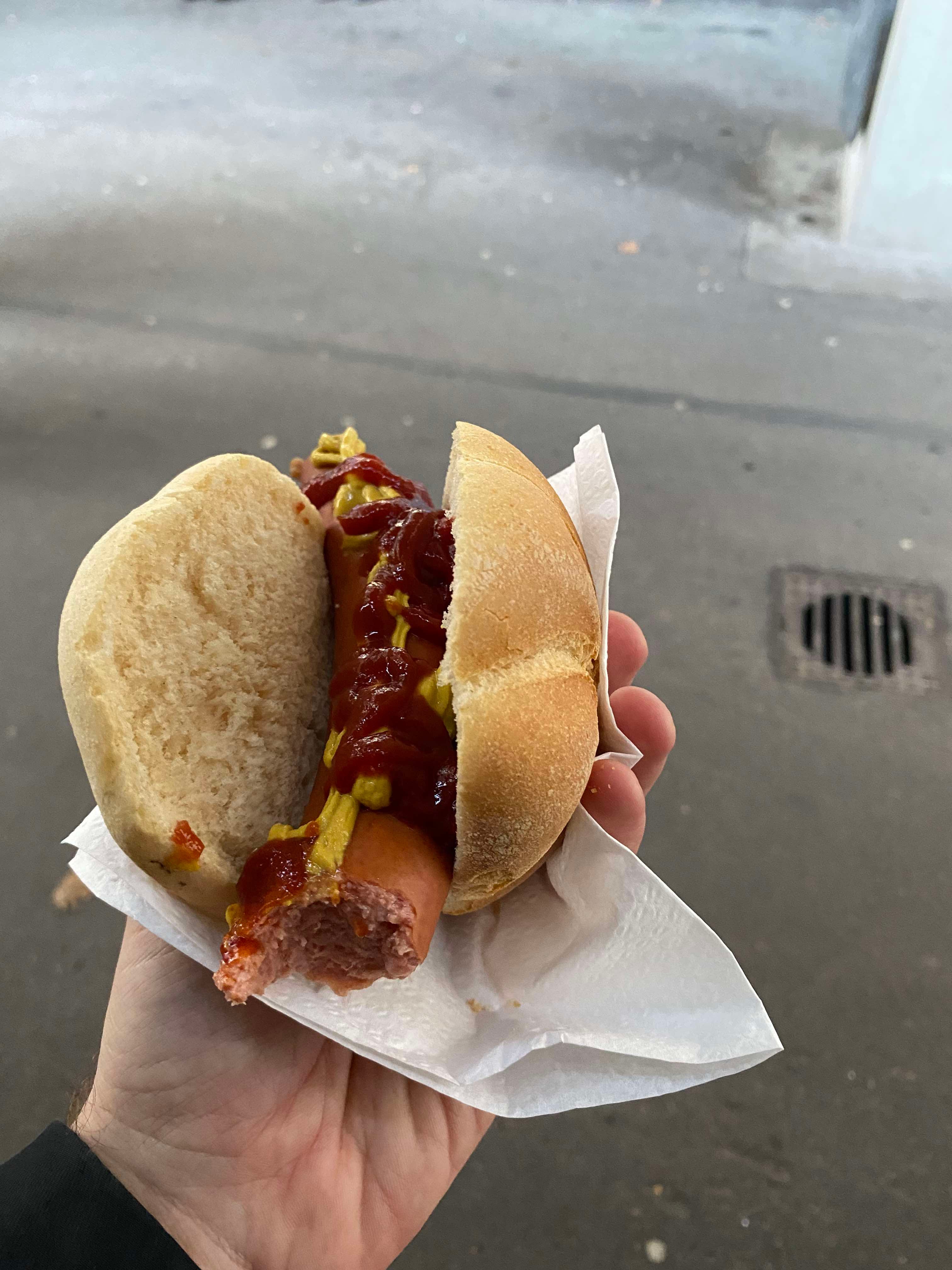
Of course, I had to sample the local fare. I bought a €5 wurst (decent), and a Spezi (a mix of orangeade and coke, better than it sounds) for the same price. Uninspiring, but it did the job. The stadium filled up relatively slowly, although a large contingent from the visitors, SV Wahldof Mannheim, were making the voices heard well before kickoff.
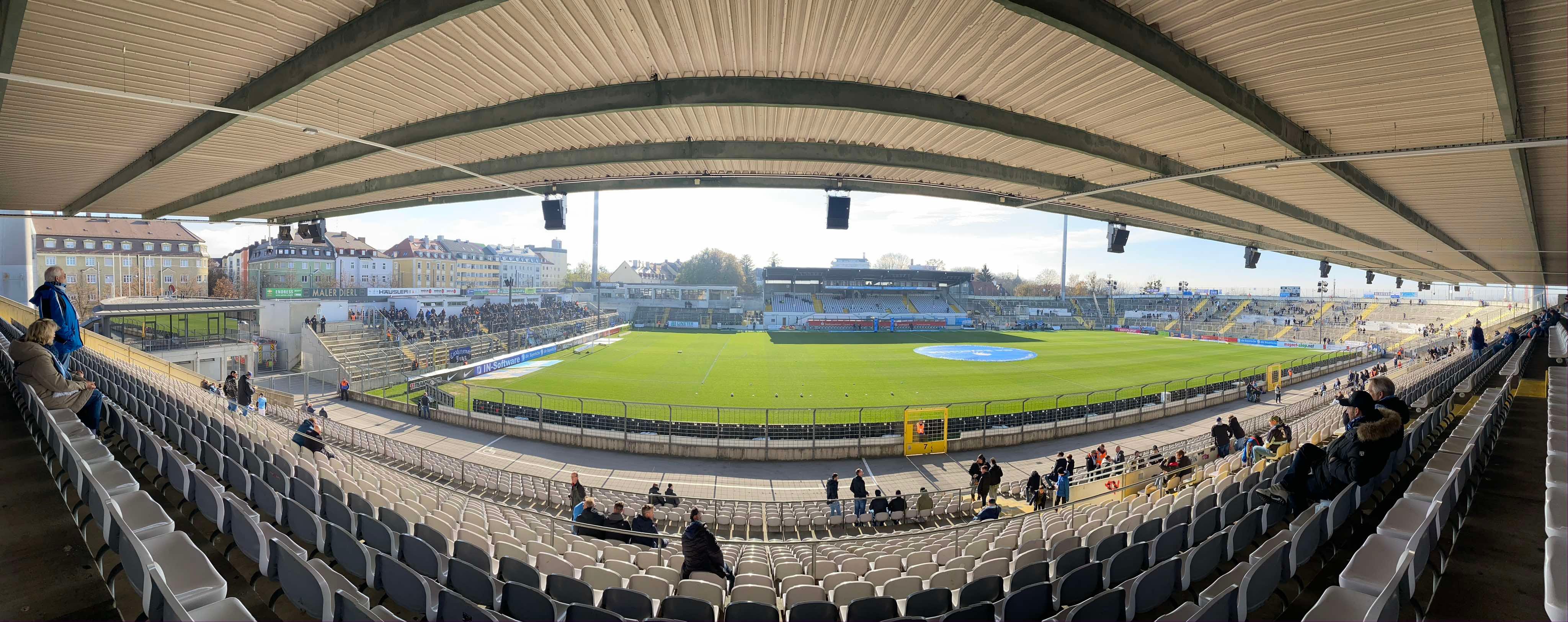
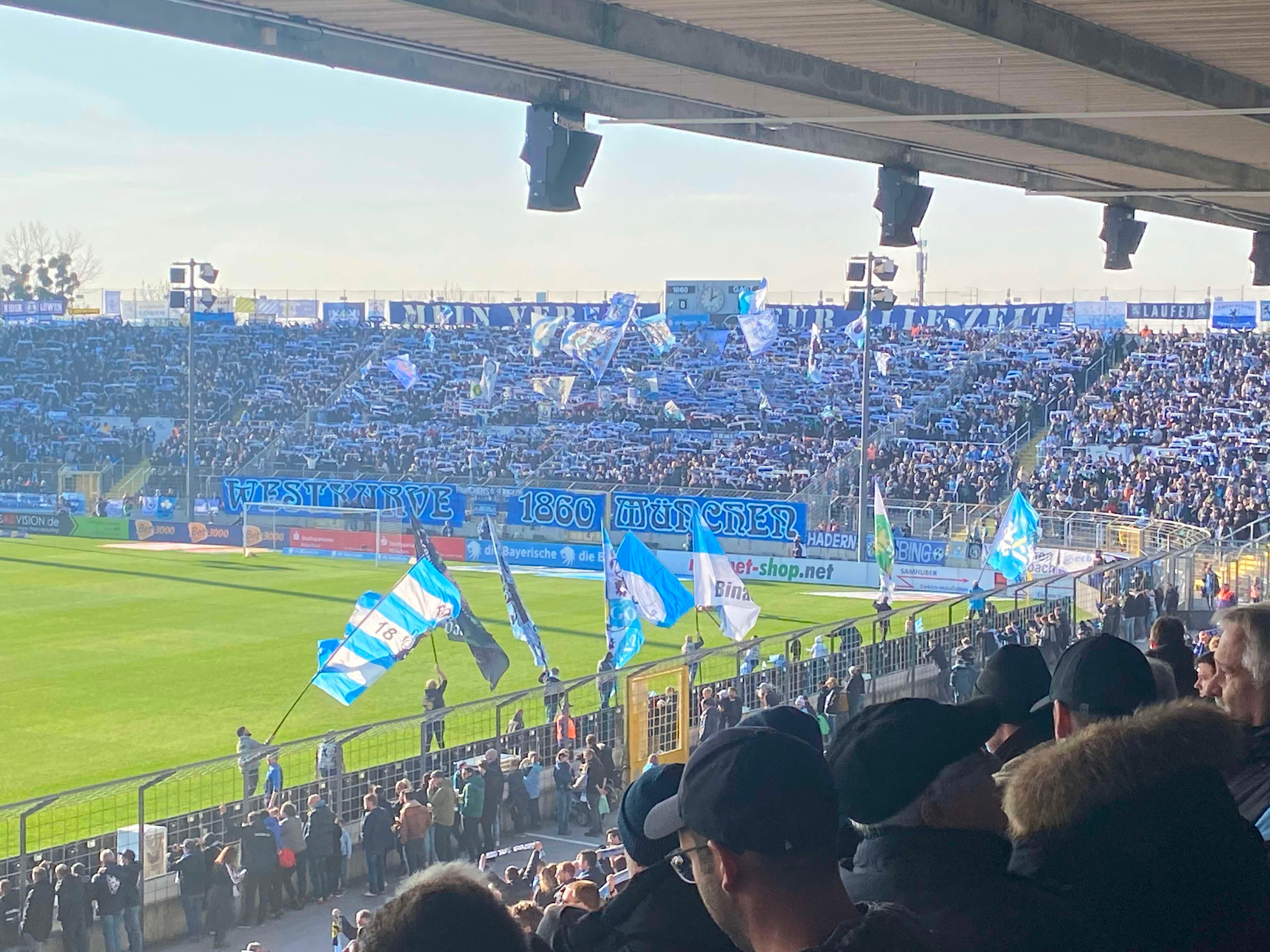
Originally constructed in 1911, Grünwalder Straße was 1860’s home until 1995. The club was originally forced to move to the Oluympiastadion before the catastrophic stay at the Allianz. The mood around the place is positive, in the seated stands, families mingle with diehard fans who’ve had a few too many as well as old lads huddling away from the bitter cold. All concrete and girders, it certainly isn’t much to look at, but it feels like someone’s home.
The first half flies by with little to note. The Lions are spirited in their pressing, constantly forcing Wahldof back towards their own goal. The few chances that are created by either side generally spring from the hosts marching up the pitch in unison, forcing an error from a slightly cack-footed keeper. It’s heartening to see a regimented and well drilled 4-4-2 garner pragmatic if unspectacular results. Mike Bassett would be proud.
During halftime I notice small children sprinting back and forth in front of the grandstand. One or two are scrabbling around on the floor, like a linebacker chasing after a fumbled football on the gridiron. A flash of plastic cuts across my eye. The inebriated blokes in the ground are throwing cups to the children, who can return them to the bars for a euro. Make the children work for their pocket money. This is proper football.
1860 came out with more purpose in the second half. Not content just to channel the formation of mid-1980s English football, they start mixing in long balls too. Working the channels relentlessly, the pressure is simply too much for Wahldof. Five minutes into the second half, a speculative ball perfectly dissects the triangle of uncertainty between a retreating fullback, a hapless centreback and an oncoming goalkeeper. Unable to make a correct decision, Wahldof’s defender sends a feeble header back towards his own box, which sets striker Julian Gattau through on goal. He duly pokes the ball home, sending the Grünwalder into raptures.
With their opponents now pushing for a goal of their own, 1860 are able to unleash devastating counterattack after devastating counterattack. Gattau and half-time substitute David Phillipp send their opposite numbers into fits, consistently cutting open Wahlfdorf’s defences. Without the interventions of Jan-Christoph Bartels in goal, and a few wasteful final passes, 1860 could have run up a cricket score. They have to settle for just two more goals. On 66 minutes, a well worked move is finished off by a ferocious nearpost strike by Tunay Deniz. Just 15 minutes later the midfielder turned provider, clipping a neat ball into Maximilian Wolfram. The big man has all day to turn and finish past a despondent Bartels. Final score: TSV 1860 Munich 3 - 0 SV Wahldof Mannheim.
By this point, my neighbours are heartily slapping me on the back, giving me jubilant high fives and getting me involved in chants. The mood around the place doesn’t feel like a former giant down its luck, but rather a club that is re-finding its place in the world, happy to take on any and all newcomers.
I head back into town in a buoyant mood. I stop off at Viktualienmarkt, the city’s main food market. Unable to make a decision on what to have for dinner, I take a small tour of the various stalls tucking into a shawarma, authentic Brezelen and some crepes for good measure. Having eyes bigger than my belly, I take an evening walk to burn some calories. I head over the river Isar, and back along its banks taking in the city at night. Munich is a pleasant and pretty place, with much of the post-war rebuilding focussing on recreating the baroque and classical style which gives it its identity. Tired from a long day, I head back to my hostel and get an early night’s sleep.
With Sunday being gameday, the next 24 hours would centre around ‘American’ football, which is of little interest to this project. Eager to see more of Munich however, I wake up early and head to the Englisher Garten. The 910 acre park is named for the English style of informal landscape that was popular in the 18th century; the garden was created in 1789. The mid-November air is biting, and a faint mist sits overhead, but the golden orange foliage makes up for the miserable weather. Runners and cyclists fly past me, but I’m content to amble along the stream, happily decompressing before a busy and action-packed day.
The garden sits to the north of the city centre, and is a perfect halfway point on the journey to the Allianz Arena. I jump back on the U-Bahn, now crowded with fans in NFL gear, the atmosphere before the game starting to build.
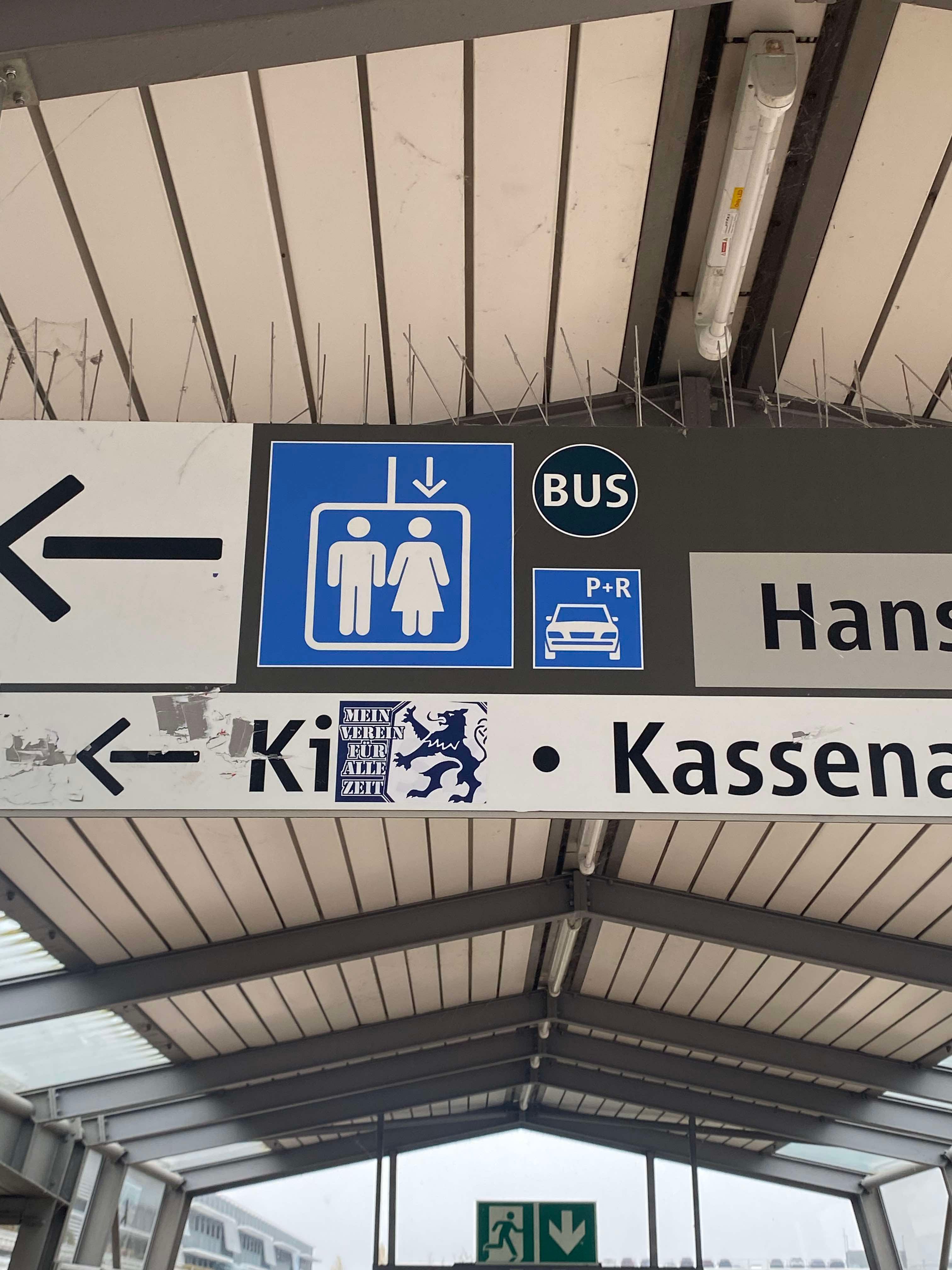
If Grünwalder felt like a classic stadium, nestled in a functioning and lively inner-city neighbourhood, the Allianz is the complete opposite. Surrounded by train tracks and motorways, it’s an unflinchingly modern ground. Maybe I’d been indoctrinated by my experience the previous day, but I found myself snobbishly denigrating the stadium before I’d even set foot in it (it was actually very impressive on the inside). It seems I was brainwashed by the Sechzig, as I couldn’t help but laugh at the numerous blue and white stickers dotted around the underground station. Affronted Bayern fans had either scribbled over them, or slapped their own labels over the top, but the message was clear. This city belongs to The Lions, no matter how many trophies you might win.